 |
 |
 |
|
 |
 |
 |
 |
 |
 |
 |
In the NewsInvasive Weeds Threaten Lake Tahoe
date posted: September 2 2003
Lake Tahoe is frequently featured in news reports lamenting the loss of the lake’s famed water clarity. What you’ll rarely read, however, is that the basin is being rapidly infested by a number of invasive weeds. These weeds are not your common garden-variety pests! Invasive weeds are a group of nonnative plants that grow like crazy, choke out native vegetation, decrease wildlife habitat, ruin recreational opportunities, and cost us millions of dollars each year for treatment and lost land productivity. One of the biggest threats they pose to the Tahoe Basin is their tendency to increase soil erosion and stream sedimentation, which can damage Tahoe’s famed clarity.
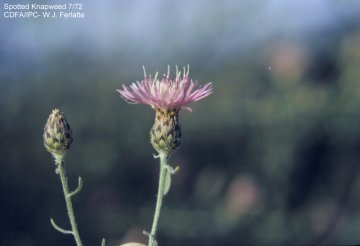
The worst of these weeds, spotted knapweed (Centaurea maculosa), has been recognized in Nevada law as a noxious weed. Spotted knapweed is a pretty, bushy plant with purple, aster-like flowers that is spreading fast in the Tahoe Basin. It is native to Eurasia, but thrives in Western climates, especially in rangeland and forest settings. In fact, it has already invaded more than 4.5 million acres in Montana and has spread west into Nevada and California.
Nevada has designated spotted knapweed as a noxious weed because it is prolific, highly competitive and difficult to control. So, by law, landowners must get rid of it. If we don’t control it now, soon we’ll have hundreds or thousands of infested acres in the basin. While you might find it to be a fairly pretty and decorative plant, studies have shown that rates of erosion and sedimentation increase as spotted knapweed invades. Unlike grasses, which have fine, fibrous, net-like roots that knit the soil together and hold it in place, spotted knapweed and other invasive weeds have a coarse tap-rooted structure that allows water to wash away the soil. Erosion is a major threat to the lake’s clarity – so the more spotted knapweed we have at the lake, the more difficult it will be to preserve the lake’s clarity.
As is the case for most noxious and invasive weeds, controlling it can be difficult, especially if it is allowed to flower and produce seed. Each plant can produce up to 18,000 seeds in one year. Early infestations of a few plants can be controlled by pulling or digging out plants. However, if plants are allowed to reproduce and seed over several seasons, the resulting “seed bank” in the soil will continue to grow weeds and will eventually crowd out native plants.
You can help halt the invasive spread of spotted knapweed by learning to identify it and by controlling it early. Its aster-like flowers sit on spotted flower bracts and bloom in mid- to late-summer. Sometimes the flowers are white or pink, but most often, they are purple. They do not have yellow centers, as asters do. The plants can be 1 foot to 3 feet tall.
Several other knapweeds are also making an appearance in the basin, including diffuse knapweed (Centaurea diffusa) and yellow starthistle (Centaurea solstitialis). These plants are somewhat similar in appearance to spotted knapweed, being related species. Diffuse knapweed has white to pale pink flowers, with spines on the bracts below the flowers. Yellow starthistle has yellow flowers, with thorns up to an inch long extending below the flower head. These thorns puncture bike tires, car tires, shoes, and more. Once you’ve seen yellow starthistle, you’ll never forget it!
If you are certain that you have identified one of these weeds on your property, dig or pull the plants and place them in tightly sealed bags in the trash. Wear leather gloves, as they can irritate human skin. Be careful to contain and dispose of all the seeds. Remove as much of the root as possible. Then, keep checking the site throughout the year, and keep removing the weed as necessary. Don’t get discouraged – eventually you will be successful!
If you spot the weed at a location along a roadside or somewhere other than on your own property, get an accurate description of the location and report it to me (Sue Donaldson, (775) 784-4848). I will take the information or refer you to the appropriate individual, depending on the county where you spotted the weed. You’ll be helping protect the lake and the lifestyle we all enjoy.
Watch for “The Lake Tahoe Report” on KOLO-TV News Channel 8 Tuesdays at 5 p.m. to learn more. Next week, learn about the California Tahoe Conservancy and the work they do on the California side of the lake. “The Lake Tahoe Report” is a collaborative effort of the Lake Tahoe Environmental Education Coalition, University of Nevada Cooperative Extension, UC Davis and the USDA Forest Service. For more information, contact Heather Segale, University of Nevada Cooperative Extension, (775) 832-4138, or logon to www.lteec.org or www.unce.unr.edu.
More News: Kids Learn to Prevent Water Pollution at Tahoe, Through a number of innovative watershed education programs in the . . . read this news. Take a Glimpse of Tahoe’s Natural History, Geologic time is hard to imagine, with vast stretches of . . . read this news. Local Schoolchildren Ready for Earth Day, In Toni Rockwell’s third-grade class at Rideout Elementary School, excitement . . . read this news. Lake Protection Efforts Seen as Model of Collaboration, When President Clinton came to Lake Tahoe in 1997, he . . . read this news. Tahoe Communities Use Various Recycling Strategies, Thanks to the careful research and creative thinking of Lake . . . read this news. The Forest Service Accomplishes Much with Help from the Lake Tahoe Restoration Act, By John Cobourn, Water Resource Specialist; Heather Segale, Environmental Education Coordinator; University . . . read this news. Managing Vegetation for Wildfire Prevention, By John Cobourn, Water Resource Specialist; Heather Segale, Environmental Education Coordinator; . . . read this news. Good News for Tahoe from Federal and State Governments, By John Cobourn, Water Resource Specialist; Heather Segale, Environmental Education Coordinator; . . . read this news. Where Does Your Drinking Water Come From?, By John Cobourn, Water Resource Specialist; and Heather Segale, Environmental Education . . . read this news. Lake Tahoe is Losing Water Clarity, Lake Tahoe waters have been losing transparency at an average . . . read this news. What do Watersheds Matter?, By Heather Segale and John Cobourn University of Nevada Cooperative Extension Most . . . read this news. Why Measure Water Clarity in Lake Tahoe?, By John Cobourn, Water Resource Specialist; and Heather Segale, Environmental . . . read this news. Special Report: Lake Tahoe Air Quality, Meteorology and Air Quality in the Lake Tahoe Airshed There are . . . read this news. Meet Greg Crofton, Tribune Environmental Reporter, In February of 2002 Greg Crofton became the environmental reporter . . . read this news. “The National Map” Lake Tahoe Area Pilot Project Underway, The U.S. Geological Survey (USGS) is developing “The National Map” . . . read this news. KOLO-TV and LTEEC Feature Weekly Information on Lake Tahoe Environment, KOLO-TV and LTEEC Feature Weekly Information on Lake Tahoe Environment The . . . read this news. Fifteen Things You Can Do To Make a Difference in Your Watershed, Learn about your watershed. Use EPA's Nonpoint Source Program web pages . . . read this news. What Kinds of Best Management Practices Work Best?, Most Lake Tahoe residents and second-homeowners know that best management . . . read this news. Choose Plants for Your Landscape Wisely, Whether you are putting in a new landscape or refurbishing . . . read this news. To Protect Water Quality, Allow your Landscape to Act Like a Sponge, What we do in our landscapes has a huge impact . . . read this news. Avoid Summer Water Waste, Especially during the summer, when our region receives very little . . . read this news. Yuck - Algae in Lake Tahoe, There are two major types of algae found in Lake . . . read this news. Living With Bears, By Ann Bryant, Executive Director, BEAR League Bears are probably the . . . read this news. Tahoe Clarity Hits 10-Year High, In 2002, Lake Tahoe was the clearest it had been . . . read this news. Lakes Tahoe and Baikal Inspire Unique Russian-American Partnership, Lakes Tahoe and Baikal Inspire Unique Russian-American Partnership The Tahoe-Baikal Institute . . . read this news. Lakes Tahoe and Baikal Inspire Unique Russian-American Partnership, Lakes Tahoe and Baikal Inspire Unique Russian-American Partnership The Tahoe-Baikal Institute . . . read this news. Use Lawn Fertilizers Sparingly at Lake Tahoe, Because landscape fertilizer is one of the most damaging of . . . read this news. What You Can Do To Protect Water Quality, Hike only on existing trails. Use fertilizers and lawn chemicals sparingly. Water . . . read this news. From Under the Water – Part One, Lake Tahoe is naturally an ultra-oligotrophic lake, meaning that it . . . read this news. From Under the Water – Part Two, The future of Lake Tahoe’s water is being shaped by . . . read this news. Wet Weather Construction can be Especially Hard on the Lake, Construction and grading activities such as earth-moving and excavating can . . . read this news. Do We Have Old-growth Forests at Tahoe?, When European-American explorers first viewed the Lake Tahoe Basin in . . . read this news. Prevent Runoff from Polluting Lake Tahoe, The terms “urban storm water” and “polluted runoff” are being . . . read this news. Enjoy the Backcountry – and Take Care of It!, One of the great joys of living in or visiting . . . read this news. Take Steps to Control Air Pollution at Lake Tahoe, Most air pollution is easy to see – it’s that . . . read this news. Where Does Tahoe’s Water Pollution Come From?, Of the six main types of water pollution, Lake Tahoe . . . read this news. Tahoe Clarity Hits 10-Year High, In 2002, Lake Tahoe was the clearest it had been . . . read this news. Good Snow Removal Practices Can Help Prevent Pollution of Lake Tahoe, Since Lake Tahoe’s watershed receives most of its precipitation each . . . read this news. Citizens Get Opportunity to Test Water Quality, Each spring, the Lake Tahoe Environmental Education Coalition (LTEEC) hosts . . . read this news. Lahontan Cutthroat Trout Released, Native to the Tahoe Basin, the Lahontan cutthroat trout is . . . read this news. Tahoe Interagency Information Management System (TIIMS) Under Development, The Tahoe Interagency Information Management System (TIIMS) project will provide . . . read this news. Forest Stewardship: Learn by Doing, By John Cobourn, Water Resource Specialist; Heather Segale, Environmental Education Coordinator; . . . read this news. Invasive Weeds Threaten Lake Tahoe, Lake Tahoe is frequently featured in news reports lamenting the . . . read this news. Spotlight on the California Tahoe Conservancy, By John Cobourn, Water Resource Specialist; Heather Segale, Environmental Education Coordinator; . . . read this news. |