 |
 |
 |
|
 |
 |
 |
 |
 |
 |
 |
In the NewsWhy Measure Water Clarity in Lake Tahoe?
date posted: February 20 2003
By John Cobourn, Water Resource Specialist; and Heather Segale, Environmental Education Coordinator; University of Nevada Cooperative Extension
Scientists have been measuring water clarity in Lake Tahoe continuously since mid-1967. A simple measurement of how far down into a lake a white Secchi Disk can be seen tells lake specialists, called limnologists, a great deal about a lake’s ecological condition.
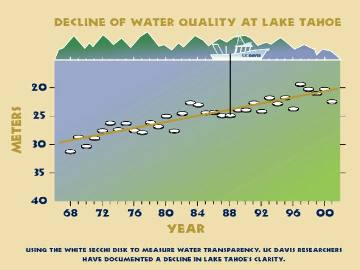
Charles Goldman, Ph.D., founder of the UC Davis Tahoe Research Group, is the limnologist who had the foresight to begin scientifically accurate measurements of Lake Tahoe’s clarity 35 years ago. Because of this, we know that the Lake’s clarity has decreased at an average rate of more than a foot a year, declining from a clarity of approximately 105 feet in 1968 to a clarity of only about 70 feet in 2001. These measurements are summarized in the Lake Tahoe Secchi Depth chart, as shown.
Unlike most graphs, this chart shows the measurements reading down from the top. This corresponds with the fact that water clarity is measured by how far down into the lake the disk can be seen by Bob Richards, UC Davis researcher, from the deck of the John LeConte, the UC Davis research vessel. Note that while the Secchi depth fluctuates depending on the weather, storm patterns and amount of precipitation each year, the trend is unmistakably toward lower clarity over the years. The rising trend line indicates decreasing Secchi depth, or water clarity.
Water clarity is an indicator of the ecological condition of a lake. When Mark Twain spoke of his amazement at seeing objects clearly on the bottom of Lake Tahoe in over a hundred feet of water, he was describing what a rare circumstance it was even 130 years ago to encounter a lake this clear. The lake was then, as it is now, an “oligotrophic” lake. That means it is exceptionally clear because there is very little suspended sediment and suspended algae in the water. Such lakes tend to be naturally clear, because their watersheds are relatively small compared to the volume of water in the lake.
The Secchi chart is telling us that we are destroying the Lake’s natural clarity. Our urbanization of Tahoe’s watershed and our pollution of the air quality over the lake have created millions of small human impacts that have added up over time. These cumulative impacts have caused more nutrients to enter the Lake and feed the free-floating algae, and more small soil particles to become suspended in the water.
Goldman is still working on Lake Tahoe. He is telling us that the water quality may move from spectacular to merely average in our lifetimes, with the color changing from blue to green. Restoration of our air quality and watershed is the only likely means to prevent this decline.
Preventing further deterioration is not just important for aesthetic reasons, but it is also important for Tahoe’s recreation-based economy, property values and the quality of our drinking water.
Watch for The Lake Tahoe Report on KOLO-TV News Channel 8 each Tuesday at 5 p.m. to learn more. The Lake Tahoe Report is a collaborative effort of the Lake Tahoe Environmental Education Coalition, University of Nevada Cooperative Extension, UC Davis and the USDA Forest Service. For more information, contact Heather Segale, University of Nevada Cooperative Extension, (775) 832-4138, segaleh@unce.unr.edu.
More News: Lake Tahoe is Losing Water Clarity, Lake Tahoe waters have been losing transparency at an average . . . read this news. What do Watersheds Matter?, By Heather Segale and John Cobourn University of Nevada Cooperative Extension Most . . . read this news. Why Measure Water Clarity in Lake Tahoe?, By John Cobourn, Water Resource Specialist; and Heather Segale, Environmental . . . read this news. Special Report: Lake Tahoe Air Quality, Meteorology and Air Quality in the Lake Tahoe Airshed There are . . . read this news. Job Announcements - Winter 2002/03, There are several Tahoe area jobs in the environmental field . . . read this news. Meet Greg Crofton, Tribune Environmental Reporter, In February of 2002 Greg Crofton became the environmental reporter . . . read this news. “The National Map” Lake Tahoe Area Pilot Project Underway, The U.S. Geological Survey (USGS) is developing “The National Map” . . . read this news. Best Management Practice Workshop Scheduled, The 4th Annual Best Management Practice Workshop, sponsored by the . . . read this news (unavailable). KOLO-TV and LTEEC Feature Weekly Information on Lake Tahoe Environment, KOLO-TV and LTEEC Feature Weekly Information on Lake Tahoe Environment The . . . read this news. Fifteen Things You Can Do To Make a Difference in Your Watershed, Learn about your watershed. Use EPA's Nonpoint Source Program web pages . . . read this news. Yuck - Algae in Lake Tahoe, There are two major types of algae found in Lake . . . read this news. Living With Bears, By Ann Bryant, Executive Director, BEAR League Bears are probably the . . . read this news. What You Can Do To Protect Water Quality, Hike only on existing trails. Use fertilizers and lawn chemicals sparingly. Water . . . read this news. Take Steps to Control Air Pollution at Lake Tahoe, Most air pollution is easy to see – it’s that . . . read this news. Where Does Tahoe’s Water Pollution Come From?, Of the six main types of water pollution, Lake Tahoe . . . read this news. Tahoe Clarity Hits 10-Year High, In 2002, Lake Tahoe was the clearest it had been . . . read this news. Good Snow Removal Practices Can Help Prevent Pollution of Lake Tahoe, Since Lake Tahoe’s watershed receives most of its precipitation each . . . read this news. Lahontan Cutthroat Trout Released, Native to the Tahoe Basin, the Lahontan cutthroat trout is . . . read this news. Tahoe Interagency Information Management System (TIIMS) Under Development, The Tahoe Interagency Information Management System (TIIMS) project will provide . . . read this news. |