 |
 |
 |
|
 |
 |
 |
 |
 |
 |
 |
In the NewsTahoe Clarity Hits 10-Year High
date posted: March 3 2003
In 2002, Lake Tahoe was the clearest it had been in 10 years, said UC Davis researchers today. The UC Davis Tahoe Research Group, which has worked with Tahoe policy-makers for more than 40 years, said the new finding could mean that science-based recovery projects in the region are making a difference.
"These are encouraging results, and we hope they indicate the beginning of the lake's recovery," said Charles Goldman, director and founder of the Tahoe Research Group.
"However, 10 years is a short time and it is too early to say if the recent improvements will continue. "We must keep up our efforts to prevent water and air pollution, or we may still end up with a green lake."
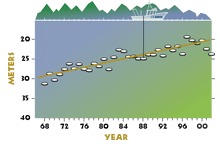
UC Davis researchers measure the lake's clarity every seven to 10 days by lowering a white, dinner-plate-sized disk (called a Secchi disk) into the water at fixed locations and noting the depth at which the disk disappears from sight.
The new data show that in 2002 Lake Tahoe clarity reached an annual average of 78 feet. It has not been that clear since 1992, when it reached 78.3 feet. This remains a far cry from 1968, when Secchi measurements began; at that time, the disk could be seen at an average depth of 102.4 feet.
Last year, lake advocates were heartened by the finding that clarity had reached a five-year high; the disk could be seen to a depth of 73.6 feet.
The UC Davis Tahoe Research Group's data are routinely used by the Tahoe Regional Planning Agency, which leads the program to restore the health of the Tahoe Basin ecosystem. The cornerstone of the agency's restoration activities is its Environmental Improvement Program, a large group of projects designed to achieve and maintain healthy natural resources.
Many of the TRPA's environmental improvement projects aim to improve lake clarity by reducing the runoff of fine sediment, which makes the water cloudy; the runoff of nutrients (such as fertilizers) that promote algae growth, which makes the water green; and the depositing of air pollution into the lake.
Goldman said those restoration activities as well as others may well have contributed to the improvement seen in 2002. He also noted that 2001 and 2002 were drier than average, which reduced runoff and could have helped clarity.
"Whether or not runoff was reduced by low precipitation or by improvement projects, or both, the lake may be showing that it can recover," Goldman said.
Added TRPA executive director Juan Palma, "We were also pleased to see a significant decrease in algae growth last year. These positive numbers should motivate us to continue our strategy of investing in soil-erosion control, storm-water treatment and transportation alternatives.
"While we can't explain with great certainty what the latest data are telling us right now, we are confident that important research currently under way at Lake Tahoe will help us answer these important questions."
Current research projects that are relevant to water clarity include a stream-loading study, a storm-water runoff study, an analysis of atmospheric pollutants and a study of turbidity along the shoreline.
The UC Davis Tahoe Research Group works on scientific problems in the basin in collaboration with local, state and federal agencies and the private sector. Research partners include the University of Nevada at Reno, Desert Research Institute, Tahoe Regional Planning Agency, Lahontan Regional Water Quality Control Board, California EPA, California Air Resources Board, Nevada Department of Environmental Protection, U.S. Environmental Protection Agency, U.S. Forest Service, and U.S. Geological Survey.
Between now and 2007, several major Tahoe Basin agencies will produce important updates of their environmental and management plans that will guide policy-making and development in the basin through 2027. In the largest Tahoe research effort yet ($6 million), more than 100 scientists will provide information to help policy-makers write the plans.
One essential component of the plans will be the development of a new water-pollution standard known as the Lake Tahoe Total Maximum Daily Load (TMDL). The pollution-load scientific work is being done by many of UC Davis' research partners; it is coordinated by UC Davis Tahoe Research Group watershed scientist John Reuter.
Reuter said that the goal of the pollution-load research is to determine what levels of pollutant reduction are necessary; the goal of the TRPA Environmental Improvement Program is to be a blueprint for how to achieve this reduction.
"The continued improvement in lake clarity in 2002 provides strong evidence that, if pollutant loading can be reduced by a sufficient magnitude, we could see an improvement in lake conditions within a decade," he said.
In other recent events, Charles Goldman was just awarded the Nevada Medal by the Desert Research Institute, in recognition of his outstanding achievements in science. He will be honored at ceremonies in Las Vegas and Reno in March by the Nevada governor and legislature.
"The value of our long-term Tahoe data can scarcely be overemphasized," Goldman said today. "This ongoing study, which began in 1959, enables us to realistically evaluate changes in the lake that are influenced by a multitude of physical, chemical, biological and meteorological processes."
Also, UC Davis continues working toward construction of a new $13.2 million research facility and education center, the Lake Tahoe Center for Environmental Research and Education. The Tahoe Regional Planning Agency governing board will hear an update on those plans at its meeting this Wednesday, Feb. 26.
For more information:
Tahoe Research Group projects are described at http://trg.ucdavis.edu/.
The Tahoe Regional Planning Agency's Environmental Improvement Program is described at http://www.trpa.org/.
The Lake Tahoe Center for Environmental Research and Education is described at http://www.ormp.ucdavis.edu/environreview/tahoe.html.
Media contact(s):
Sylvia Wright, UC Davis News Service, (530) 752-7704, swright@ucdavis.edu
More News: Kids Learn to Prevent Water Pollution at Tahoe, Through a number of innovative watershed education programs in the . . . read this news. Take a Glimpse of Tahoe’s Natural History, Geologic time is hard to imagine, with vast stretches of . . . read this news. Local Schoolchildren Ready for Earth Day, In Toni Rockwell’s third-grade class at Rideout Elementary School, excitement . . . read this news. Lake Protection Efforts Seen as Model of Collaboration, When President Clinton came to Lake Tahoe in 1997, he . . . read this news. Tahoe Communities Use Various Recycling Strategies, Thanks to the careful research and creative thinking of Lake . . . read this news. The Forest Service Accomplishes Much with Help from the Lake Tahoe Restoration Act, By John Cobourn, Water Resource Specialist; Heather Segale, Environmental Education Coordinator; University . . . read this news. Managing Vegetation for Wildfire Prevention, By John Cobourn, Water Resource Specialist; Heather Segale, Environmental Education Coordinator; . . . read this news. Good News for Tahoe from Federal and State Governments, By John Cobourn, Water Resource Specialist; Heather Segale, Environmental Education Coordinator; . . . read this news. Where Does Your Drinking Water Come From?, By John Cobourn, Water Resource Specialist; and Heather Segale, Environmental Education . . . read this news. Lake Tahoe is Losing Water Clarity, Lake Tahoe waters have been losing transparency at an average . . . read this news. What do Watersheds Matter?, By Heather Segale and John Cobourn University of Nevada Cooperative Extension Most . . . read this news. Why Measure Water Clarity in Lake Tahoe?, By John Cobourn, Water Resource Specialist; and Heather Segale, Environmental . . . read this news. Special Report: Lake Tahoe Air Quality, Meteorology and Air Quality in the Lake Tahoe Airshed There are . . . read this news. Meet Greg Crofton, Tribune Environmental Reporter, In February of 2002 Greg Crofton became the environmental reporter . . . read this news. “The National Map” Lake Tahoe Area Pilot Project Underway, The U.S. Geological Survey (USGS) is developing “The National Map” . . . read this news. KOLO-TV and LTEEC Feature Weekly Information on Lake Tahoe Environment, KOLO-TV and LTEEC Feature Weekly Information on Lake Tahoe Environment The . . . read this news. Fifteen Things You Can Do To Make a Difference in Your Watershed, Learn about your watershed. Use EPA's Nonpoint Source Program web pages . . . read this news. What Kinds of Best Management Practices Work Best?, Most Lake Tahoe residents and second-homeowners know that best management . . . read this news. Choose Plants for Your Landscape Wisely, Whether you are putting in a new landscape or refurbishing . . . read this news. To Protect Water Quality, Allow your Landscape to Act Like a Sponge, What we do in our landscapes has a huge impact . . . read this news. Avoid Summer Water Waste, Especially during the summer, when our region receives very little . . . read this news. Yuck - Algae in Lake Tahoe, There are two major types of algae found in Lake . . . read this news. Living With Bears, By Ann Bryant, Executive Director, BEAR League Bears are probably the . . . read this news. Tahoe Clarity Hits 10-Year High, In 2002, Lake Tahoe was the clearest it had been . . . read this news. Lakes Tahoe and Baikal Inspire Unique Russian-American Partnership, Lakes Tahoe and Baikal Inspire Unique Russian-American Partnership The Tahoe-Baikal Institute . . . read this news. Lakes Tahoe and Baikal Inspire Unique Russian-American Partnership, Lakes Tahoe and Baikal Inspire Unique Russian-American Partnership The Tahoe-Baikal Institute . . . read this news. Use Lawn Fertilizers Sparingly at Lake Tahoe, Because landscape fertilizer is one of the most damaging of . . . read this news. What You Can Do To Protect Water Quality, Hike only on existing trails. Use fertilizers and lawn chemicals sparingly. Water . . . read this news. From Under the Water – Part One, Lake Tahoe is naturally an ultra-oligotrophic lake, meaning that it . . . read this news. From Under the Water – Part Two, The future of Lake Tahoe’s water is being shaped by . . . read this news. Wet Weather Construction can be Especially Hard on the Lake, Construction and grading activities such as earth-moving and excavating can . . . read this news. Do We Have Old-growth Forests at Tahoe?, When European-American explorers first viewed the Lake Tahoe Basin in . . . read this news. Prevent Runoff from Polluting Lake Tahoe, The terms “urban storm water” and “polluted runoff” are being . . . read this news. Enjoy the Backcountry – and Take Care of It!, One of the great joys of living in or visiting . . . read this news. Take Steps to Control Air Pollution at Lake Tahoe, Most air pollution is easy to see – it’s that . . . read this news. Where Does Tahoe’s Water Pollution Come From?, Of the six main types of water pollution, Lake Tahoe . . . read this news. Tahoe Clarity Hits 10-Year High, In 2002, Lake Tahoe was the clearest it had been . . . read this news. Good Snow Removal Practices Can Help Prevent Pollution of Lake Tahoe, Since Lake Tahoe’s watershed receives most of its precipitation each . . . read this news. Citizens Get Opportunity to Test Water Quality, Each spring, the Lake Tahoe Environmental Education Coalition (LTEEC) hosts . . . read this news. Lahontan Cutthroat Trout Released, Native to the Tahoe Basin, the Lahontan cutthroat trout is . . . read this news. Tahoe Interagency Information Management System (TIIMS) Under Development, The Tahoe Interagency Information Management System (TIIMS) project will provide . . . read this news. Invasive Weeds Threaten Lake Tahoe, Lake Tahoe is frequently featured in news reports lamenting the . . . read this news. |