 |
 |
 |
|
 |
 |
 |
 |
 |
 |
 |
In the NewsFrom Under the Water – Part One
date posted: June 9 2003
Lake Tahoe is naturally an ultra-oligotrophic lake, meaning that it has extraordinary clarity in part because of extremely low rates of algae growth in its water. In lakes, microscopic free-floating algae plants are the primary producers of food for other lake organisms. Tahoe has a naturally unproductive aquatic ecosystem, compared to the vast majority of lakes in the world. That is one of the reasons its water is among the clearest and most transparent of any large lake in the world.
Does that mean the aquatic ecosystem is barren or uninteresting? Well, not if you like ecology and find out what is actually there. There are many different species of free-floating microscopic algae, called phytoplankton, in Lake Tahoe. One of the most abundant types of algae here is the diatom. Diatoms have a hard glass-like silica shell surrounding their biomass, and when they die and sink to the bottom, they make deposits that have been mined as diatomaceous earth where shallow seas have dried up.
Some microscopic algae plants have a tiny whip-like flagellum, allowing them to swim in search of nutrients. In the summer, throughout the lake, various species of algae stratify into layers from the warm bright surface of the water to the lowest edge of the zone of light penetration, more than 350 feet below the surface. Some algae swim up to the surface for photosynthesis during the daylight and back down to harvest nutrients each night.
The favorite foods of these plants are dissolved Nitrogen and Phosphorous. Scientists have learned that phytoplankton generally thrives and grows fastest when it can find 16 atoms of nitrogen for each atom of Phosphorus. This atomic ratio of 16:1 forms the balanced diet for algae.
Since Tahoe has relatively low concentrations of plant nutrients in its water, the growth of algae throughout the lake is limited. As more nitrogen and phosphorus are added to the lake through erosion and other forms of pollution, growth will increase. Currently, because so much nitrogen is deposited into the lake out of the atmosphere, there is a slight excess of nitrogen with regard to the 16:1 ratio (called the Redfield Ratio). Because of that, many species of algae will not increase their growth rate unless we add more Phosphorus to the water. The lake is currently “phosphorus-limited”.
Scientists reported in the Lake Tahoe Watershed Assessment (2000) that the most effective way to limit the decline in lake clarity is to reduce the amount of phosphorus and fine sediment particles that are delivered into the lake each year. Fine sediment particles not only absorb and scatter light like phytoplankton, but they also carry attached phosphorus that becomes available as food for algae. To reduce phosphorus and fine sediment inflow, scientists recommend best management practices (BMPs), which are land management practices that reduce erosion, promote infiltration of runoff down into the ground, and prevent fertilizers or other sources of plant nutrients from moving from the land to the lake.
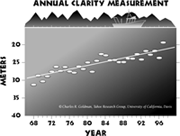
Scientists have shown that the rate of algal growth has been steadily growing in Lake Tahoe. While most residents have seen the Tahoe Research Group’s Secchi Depth chart, not as many have looked at the chart showing the rise in the algal growth in the past 40 years. In fact, the rate of algae growth in Lake Tahoe has quadrupled since 1959. This trend continues to increase at a rate of approximately 5 percent to 6 percent per year.
Kendrick Taylor of the Desert Research Institute (DRI) is one of many scientists currently studying Tahoe’s water. He measures near-shore water quality several times each month in order to identify areas with poor water quality and to determine how different weather conditions influence water quality. He has measured the turbidity, or lack of clarity, of the water at the mouths of most of Lake Tahoe’s 63 tributary streams. His near-shore turbidity measurements show the combined effects of the fine suspended soil particles and the microscopic algae that cloud the water in locations around the lake. One of the most significant findings of his research is that the lake exhibits plumes of turbid water near the outlets of streams that drain urbanized land, such as Tahoe City, South Lake Tahoe, Incline Village and Kings Beach. This provides further evidence that it is human land use that contributes the pollutants that are causing the loss of Tahoe’s clarity.
Dr. Charles Goldman and other authors of the Watershed Assessment have stated that current rates of pollution will, if continued, result in a lake that is turning green and of merely “ordinary” clarity by the year 2030. The algae are bent on surviving and reproducing. It is up to us to slow down the rate at which we are providing the food for their growth.
Watch for "The Lake Tahoe Report” each week on Tuesdays at 5 p.m. to learn more. Next week, we will continue our look under the waters of Tahoe and its microscopic world, and see how this world and our actions will shape the future of the lake. The “Enviro Report” is a collaborative effort of the Lake Tahoe Environmental Education Coalition, University of Nevada Cooperative Extension, UC Davis and the USDA Forest Service. For more information, contact Heather Segale, University of Nevada Cooperative Extension, (775) 832-4138, or logon to www.lteec.org or www.unce.unr.edu.
More News: Kids Learn to Prevent Water Pollution at Tahoe, Through a number of innovative watershed education programs in the . . . read this news. Take a Glimpse of Tahoe’s Natural History, Geologic time is hard to imagine, with vast stretches of . . . read this news. Local Schoolchildren Ready for Earth Day, In Toni Rockwell’s third-grade class at Rideout Elementary School, excitement . . . read this news. Lake Protection Efforts Seen as Model of Collaboration, When President Clinton came to Lake Tahoe in 1997, he . . . read this news. Lake Tahoe is Losing Water Clarity, Lake Tahoe waters have been losing transparency at an average . . . read this news. What do Watersheds Matter?, By Heather Segale and John Cobourn University of Nevada Cooperative Extension Most . . . read this news. Why Measure Water Clarity in Lake Tahoe?, By John Cobourn, Water Resource Specialist; and Heather Segale, Environmental . . . read this news. Special Report: Lake Tahoe Air Quality, Meteorology and Air Quality in the Lake Tahoe Airshed There are . . . read this news. Meet Greg Crofton, Tribune Environmental Reporter, In February of 2002 Greg Crofton became the environmental reporter . . . read this news. “The National Map” Lake Tahoe Area Pilot Project Underway, The U.S. Geological Survey (USGS) is developing “The National Map” . . . read this news. KOLO-TV and LTEEC Feature Weekly Information on Lake Tahoe Environment, KOLO-TV and LTEEC Feature Weekly Information on Lake Tahoe Environment The . . . read this news. Fifteen Things You Can Do To Make a Difference in Your Watershed, Learn about your watershed. Use EPA's Nonpoint Source Program web pages . . . read this news. What Kinds of Best Management Practices Work Best?, Most Lake Tahoe residents and second-homeowners know that best management . . . read this news. Choose Plants for Your Landscape Wisely, Whether you are putting in a new landscape or refurbishing . . . read this news. To Protect Water Quality, Allow your Landscape to Act Like a Sponge, What we do in our landscapes has a huge impact . . . read this news. Yuck - Algae in Lake Tahoe, There are two major types of algae found in Lake . . . read this news. Living With Bears, By Ann Bryant, Executive Director, BEAR League Bears are probably the . . . read this news. Tahoe Clarity Hits 10-Year High, In 2002, Lake Tahoe was the clearest it had been . . . read this news. Lakes Tahoe and Baikal Inspire Unique Russian-American Partnership, Lakes Tahoe and Baikal Inspire Unique Russian-American Partnership The Tahoe-Baikal Institute . . . read this news. Lakes Tahoe and Baikal Inspire Unique Russian-American Partnership, Lakes Tahoe and Baikal Inspire Unique Russian-American Partnership The Tahoe-Baikal Institute . . . read this news. Use Lawn Fertilizers Sparingly at Lake Tahoe, Because landscape fertilizer is one of the most damaging of . . . read this news. What You Can Do To Protect Water Quality, Hike only on existing trails. Use fertilizers and lawn chemicals sparingly. Water . . . read this news. From Under the Water – Part One, Lake Tahoe is naturally an ultra-oligotrophic lake, meaning that it . . . read this news. From Under the Water – Part Two, The future of Lake Tahoe’s water is being shaped by . . . read this news. Wet Weather Construction can be Especially Hard on the Lake, Construction and grading activities such as earth-moving and excavating can . . . read this news. Do We Have Old-growth Forests at Tahoe?, When European-American explorers first viewed the Lake Tahoe Basin in . . . read this news. Prevent Runoff from Polluting Lake Tahoe, The terms “urban storm water” and “polluted runoff” are being . . . read this news. Enjoy the Backcountry – and Take Care of It!, One of the great joys of living in or visiting . . . read this news. Take Steps to Control Air Pollution at Lake Tahoe, Most air pollution is easy to see – it’s that . . . read this news. Where Does Tahoe’s Water Pollution Come From?, Of the six main types of water pollution, Lake Tahoe . . . read this news. Tahoe Clarity Hits 10-Year High, In 2002, Lake Tahoe was the clearest it had been . . . read this news. Good Snow Removal Practices Can Help Prevent Pollution of Lake Tahoe, Since Lake Tahoe’s watershed receives most of its precipitation each . . . read this news. Citizens Get Opportunity to Test Water Quality, Each spring, the Lake Tahoe Environmental Education Coalition (LTEEC) hosts . . . read this news. Lahontan Cutthroat Trout Released, Native to the Tahoe Basin, the Lahontan cutthroat trout is . . . read this news. Tahoe Interagency Information Management System (TIIMS) Under Development, The Tahoe Interagency Information Management System (TIIMS) project will provide . . . read this news. |