 |
 |
 |
|
 |
 |
 |
 |
 |
 |
 |
In the NewsFifteen Things You Can Do To Make a Difference in Your Watershed
date posted: January 11 2002
- Learn about your watershed.
- Use EPA's Nonpoint Source Program web pages to learn about how nonpoint source pollution affects your watershed and your coastal watershed. Identify ways you can help prevent polluted runoff from your home and find out how you can be part of the solution, instead of part of the problem.
- Go on a Wetlands Walk, Estuary Walk, Lake Walk, Stream Walk, or River Walk and make observations and assessments of waterbody conditions. If you see anything abnormal (such as dead fish, oil spills, leaking barrels, and other pollution) contact your city or county environmental department right away and report the nature and location of the problem.
- Find out about precious local resources and learn about pressures on your watershed.
- Learn how land use and development decisions affect your water resources and how watershed planning and the watershed approach can help. Also learn about alternatives to current development patterns such as low-impact development and smart growth.
- Become Active in Your Watershed. Find a watershed organization (like LTEEC) in your community and volunteer to help.
- Become a Volunteer Water Quality Monitor. Help collect water quality data and build stewardship for your local waterbody. Attend a training workshop to learn proper monitoring techniques and safety rules.
- Organize or join in the cleanup of a beach, stream, estuary, or wetland.
- Create a Wildlife Habitat in your Backyard, Workplace or Schoolyard.
- Participate in or help coordinate a special wetlands activity during the month of May to celebrate American Wetlands Month. Also, celebrate International Migratory Bird Day on Saturday May 12, 2001 by joining in an event to raise awareness about the importance of birds, biological diversity, and wetlands.
- Help Increase Public Awareness in Your Watershed. Enter environmental art and poetry contests. For example, the International "River of Words" Poetry and Art contest is open to youth between the ages of 5 to 19 and invites children to explore and interpret their local watershed through the arts. Similar sites include the National Institute of Environmental Health Sciences' Environmental Art and Poetry Gallery and Environmental Defense Fund's Kids' Poems for a New Millennium.
- Prepare a presentation about your watershed for a school or civic organization. Explain what a watershed is. Discuss water quality threats, including polluted runoff and habitat loss. Highlight things people can do to protect water quality, including limiting fertilizer use and eliminating herbicides and pesticides. Be sure to provide case studies from other watersheds and to highlight success stories. Research your presentation using a variety of water education materials.
- Organize a Storm Drain Stenciling Project in your neighborhood. Produce and distribute a flyer or door hanger for households to remind residents that storm drains dump directly into your local waterbody.
- Sponsor or volunteer to participate in a Watershed Festival in your community to raise awareness about the importance of watershed protection.
- Learn how to fund your watershed outreach and public education efforts. Use the following EPA resources to get started: the Environmental Education Grants Program, the Catalog of Federal Funding Sources for Watershed Protection, Environmental Finance Program, and the Clean Water State Revolving Fund Program.
Getting Involved in Your Watershed is sponsored by the United States Environmental Protection Agency Office of Water. Visit www.epa.gov/owow/watershed/earthday/earthday.html for more information.
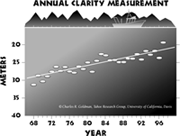
More News: Lake Tahoe is Losing Water Clarity, Lake Tahoe waters have been losing transparency at an average . . . read this news. Fifteen Things You Can Do To Make a Difference in Your Watershed, Learn about your watershed. Use EPA's Nonpoint Source Program web pages . . . read this news. Grant Awarded to Tahoe Basin, Adopt-A-Watershed (AAW), Sierra Watershed Education Partnerships (SWEP) and the Lake . . . read this news. |